

(Kitco NewsWire) – Spot gold and silver prices were modestly higher in early U.S. trading Friday, recovering from Thursday's heavy losses as bargain hunting emerged after gold fell to its lowest level in more than a year. A mixed U.S. producer inflation report offered limited relief from expectations for additional Federal Reserve tightening, while elevated Treasury yields and a strong dollar continued to constrain the recovery. Spot gold was trading near $3,891.50 an ounce, up $15.10, or 0.39%, while spot silver was trading near $49.960 an ounce, up $0.010, or 0.02%.
The U.S. Labor Department reported Friday that the producer price index increased 0.3% in October, below economists' expectations for a 0.4% gain and slowing sharply from September's revised 1.4% increase. However, annual producer inflation accelerated to 6.5%, its highest level since November 2022. Prices for final demand goods increased 0.5%, while services prices rose 0.2%. The index excluding food, energy and trade services advanced 0.5%, matching September's increase and indicating persistent underlying cost pressure. The report followed Tuesday's hotter-than-expected consumer inflation figures and Friday's stronger-than-expected October employment report from the previous week, which showed 165,000 new jobs and unemployment falling to 4.1%. Taken together, the data suggest that inflation remains elevated despite signs of moderation in some monthly price measures.
Market positioning remains focused on the Fed's Dec. 8-9 monetary policy meeting, with futures assessments indicating approximately an 89% probability of a 25-basis-point increase and an 11% probability of a 50-basis-point move before Friday's producer inflation release. New York Federal Reserve President John Williams indicated Thursday that additional policy action would likely be necessary to bring inflation under control, while also emphasizing the need to avoid excessive damage to employment. The smaller-than-expected headline PPI increase could moderate expectations for aggressive tightening, but persistent underlying producer inflation limits the case for a significant reduction in rate expectations. Investors will next assess Monday's Empire State manufacturing survey, Tuesday's October retail sales figures and the minutes of the Fed's October meeting, scheduled for Wednesday, Nov. 18.
The Strait of Hormuz and U.S.-Iran situation remains unresolved as Washington maintains its naval blockade of Iran, with President Donald Trump indicating that a comprehensive agreement is not necessary to end the conflict. The administration's apparent preference for continued economic pressure rather than renewed large-scale military operations has reduced some immediate escalation concerns, but attacks on commercial tankers and Saudi Arabian energy infrastructure by Iranian-aligned Houthi forces continue to threaten regional petroleum supplies. Maritime restrictions, elevated insurance costs and unresolved disputes over Iran's nuclear activities and sanctions leave the strategic shipping corridor vulnerable to further disruption. For gold, the continuing confrontation supports defensive demand, although the potential inflationary consequences of higher energy prices also reinforce expectations for restrictive Federal Reserve monetary policy.
Crude oil prices were mixed to slightly lower in early Friday trading and remained on course for a second consecutive weekly decline. Brent crude futures traded near $95.54 a barrel, while Nymex WTI was around $88.18 in the latest verified early-morning observations. Both benchmarks remained volatile as traders weighed the continuation of the U.S. blockade against the reduced likelihood of an immediate military escalation. Oil prices are still carrying a geopolitical risk premium, but their retreat from October's highs has provided some relief from energy-driven inflation concerns.
Global equity markets were mixed ahead of the U.S. open as investors assessed the producer inflation report, rising Treasury yields and continuing uncertainty surrounding artificial intelligence investment. U.S. stock index futures were modestly higher following Thursday's losses, when the Dow Jones Industrial Average declined approximately 0.4%, the S&P 500 fell 0.4% and the Nasdaq Composite lost 0.4%. European markets were mixed in early trading, while Asian equities generally weakened amid concerns about technology-sector valuations and restrictive monetary policy. Investors also monitored Nvidia following the resignation of chief executive Jensen Huang and a global Microsoft service disruption that affected several enterprise software products.
The key outside markets see Nymex WTI crude oil futures near $88.18 a barrel and Brent crude around $95.54. The benchmark 10-year U.S. Treasury yield was near 5.13%, while the two-year yield traded around 4.86%. The dollar index held above 103, maintaining pressure on precious metals despite Friday's tentative price recovery. (Kitco Global Index shows how much of today's gold move is the dollar versus the gold market itself.)
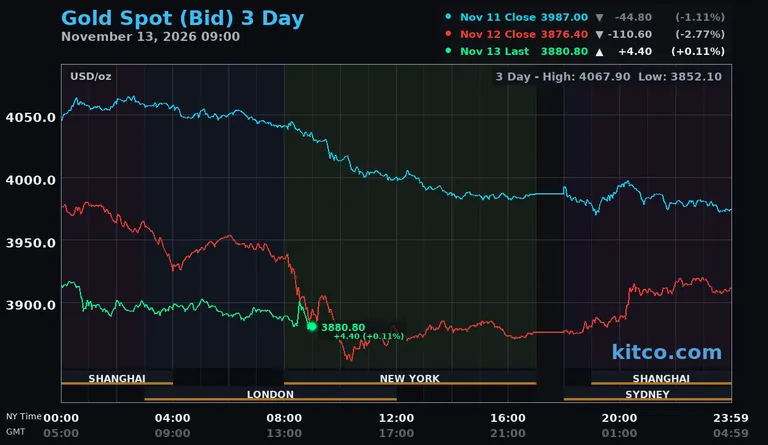
Technically, spot gold bulls' next upside price objective is to push prices back above the $3,903.00 to $3,934.00 resistance zone, with a sustained move through the upper boundary targeting $3,970.14 and then $4,002.92. Bears' next near-term downside price objective is a break below $3,852.00, with deeper downside targets at $3,823.00 and then $3,821.99. First resistance is seen at $3,903.00 and then at $3,911.36. First support is seen at $3,852.00 and then at $3,823.00.
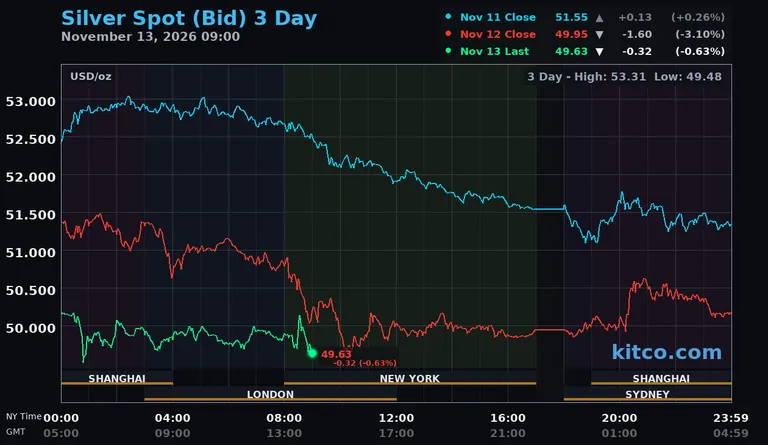
Spot silver bulls' next upside price objective is to drive prices back above the $50.592 to $50.720 resistance zone, with a sustained move targeting $51.480 and then $51.950. The next downside price objective for the bears is a break below $49.670, with deeper downside targets at $49.230 and then $48.650. First resistance is seen at $50.592 and then at $50.720. Next support is seen at $49.670 and then at $49.230.
See live precious metals prices for gold, silver, platinum and palladium — in USD, CAD and 12 more currencies.

