
(Kitco News) - Growing fears that rising inflation will force the Federal Reserve to raise interest rates aggressively next month are weighing on gold, with the yellow metal down more than 1% on the day. However, silver is significantly outperforming, with prices holding above $51 an ounce, up 0.68% on the day.
Although the gold-silver ratio is falling, one bank expects the overall trend to remain higher as silver’s industrial demand continues to weaken.
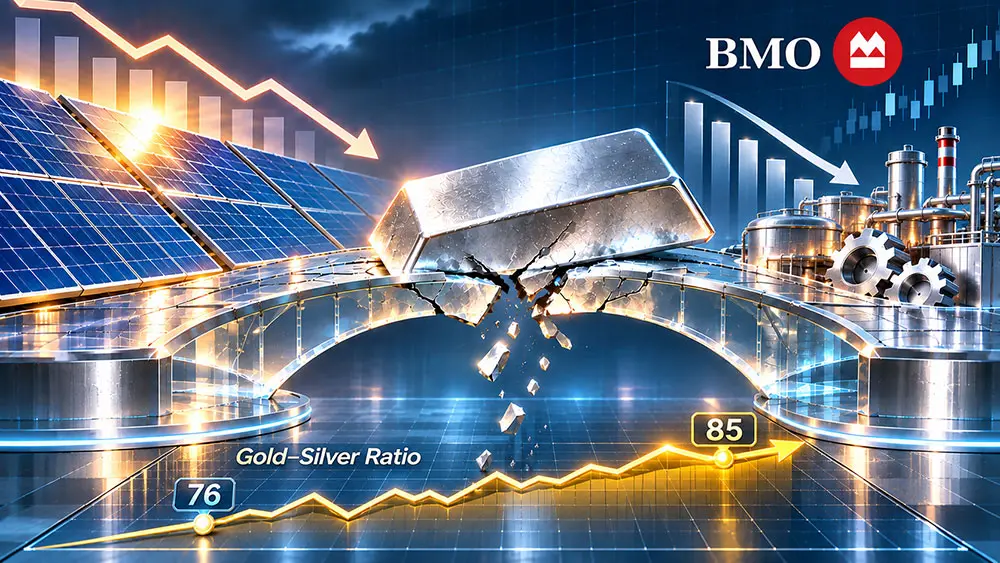
In a new report, the commodity team at BMO Capital Markets, led by George Heppel and Helen Amos, said that the gold-silver ratio has embarked on a structural uptrend and is expected to trade around 85 points over the next four years, up from 76 points currently.
The analysts said that the biggest risk for silver is that it is losing its primary growth driver: the solar sector.
The analysts pointed out that the solar sector is suffering from its own success, and the world is now dealing with a glut of renewable energy.
“Renewable capacity has grown faster than the infrastructure needed to accommodate it. Grids, interconnectors, batteries and other sources of flexible demand simply have not kept pace,” the analysts said.
Not only is the silver market expected to see slowing demand from solar installations, but the precious metal’s rise to $120 an ounce earlier this year has also created a new source of weakness.
“The surge in prices, which briefly took silver above $120/oz earlier this year, has created an enormous incentive for solar manufacturers to accelerate thrifting — and increasingly, replace silver altogether. Photovoltaic silver intensity had already been on a downward trend in recent years,” the analysts said.
BMO said that the problem facing the silver market is that falling industrial demand could undermine its key investment thesis. Robust industrial demand over the last few years has eaten away at significant above-ground stockpiles, leaving the market vulnerable to supply shocks and price volatility. Investors have jumped into the market, anticipating that higher prices will be needed to meet demand.
However, BMO expects weakening solar demand to eventually reverse years of supply deficits.
“On our estimates, the consumption surplus rises to a historical record high by 2030, driven principally by the reversal in solar demand. Those excess ounces still need to find a home, and history suggests that doing so requires silver to trade at a sufficiently low relative price to incentivise investors to absorb them,” the analysts said.
Although investment demand is expected to remain a key pillar of the market, BMO pointed out that it won’t be enough to offset the loss of demand from the solar sector.
“For silver not merely to hold today's elevated price but to continue marching higher while solar demand contracts, investors will need to absorb an unprecedented quantity of surplus metal at an increasingly high dollar cost,” the analysts said. “The bull case increasingly requires investment demand not just to remain strong, but to remain exceptionally strong for years.”
See live precious metals prices for gold, silver, platinum and palladium — in USD, CAD and 12 more currencies.

