
(Kitco News) – Gold has a long and storied history as a reliable store of wealth during times of economic strife, and according to an analysis of the yellow metal's largest price runs over the past 50 years, “The market now finds itself in a longer-lasting gold run than any since the U.S. fully abandoned the gold standard in August 1971.”
“Gold possesses several critical qualities that have solidified its reputation as a wise hedge against instability,” said Brad Chastain, director of education at U.S. Money Reserve. “Gold’s conductivity, corrosion resistance, and malleability give it intrinsic value, particularly in electronics. As a physical asset, gold has no counterparty risk, making it safer than some other financial instruments reliant on issuers or other parties.”
Chastain said these attributes have become more relevant to consumers in recent years amid an uptick in political turmoil, trade wars, the COVID pandemic, and inflation, which has helped boost the price of gold as demand increased.
“Trends in the price of gold demonstrate the asset’s growing appeal among those seeking a stable, reliable store of wealth during this period,” he said. “Over the past five years, the weekly spot price of gold has increased by more than 70%, from around $1,400/oz. in June 2019 to over $2,400/oz in July 2024.”
Chastain noted that “Relative to the performance of the Dow Jones Industrial Average, gold has exhibited stability. After a sharp decline early in the pandemic, coinciding with a spike in gold prices and declining stock performance, the Dow-to-gold ratio has leveled off over the last few years.”
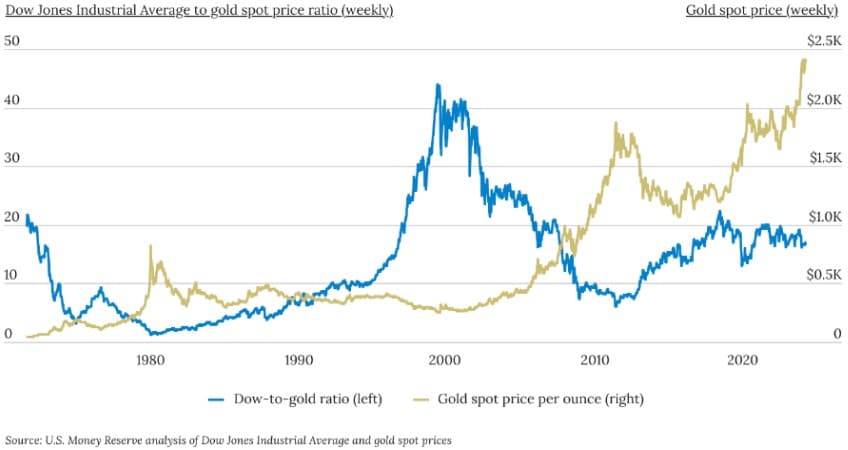
“The recent surge in gold prices amid political and economic instability is merely the latest instance of gold’s price increasing during periods of broader uncertainty,” he said. “Gold prices climbed in the years following the U.S.’s abandonment of the gold standard in the early 1970s and continued to rise throughout the ‘stagflation’ of the late 1970s and early 1980s.”
“Prices resumed their upward trajectory after the dot-com bubble burst and recession of the early 2000s, then skyrocketed in the wake of the Great Recession of 2008 as the federal government implemented expansionary monetary policies to stimulate the economy,” he added. “Prices remained elevated post-recession and have accelerated in recent years.”
Due to the gains seen since the start of the COVID pandemic, Chastain said, “The market now finds itself in a longer-lasting gold run than any since the U.S. fully abandoned the gold standard in August 1971.”
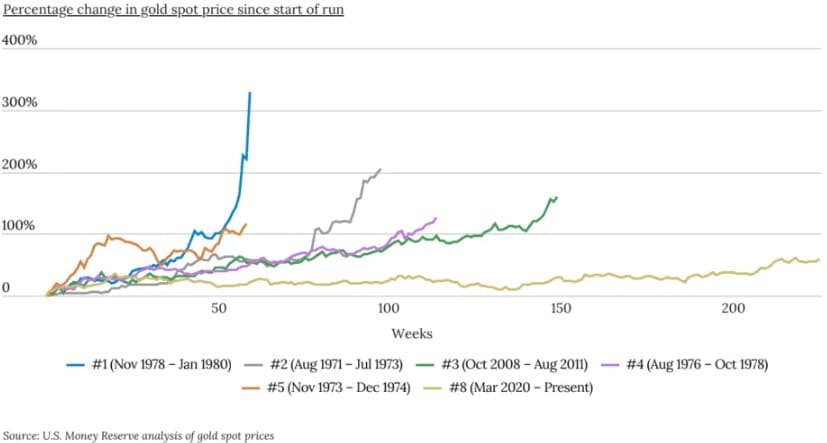
He noted that a gold run is defined “as a period of at least six months of spot price growth without a 30% decline.”
“The current 228-week run began in March 2020 – when COVID-19 initially disrupted large portions of the global economy – and has resulted in a 59% increase to the spot price of gold,” Chastain said. “While exceptional in duration, the current gold run ranks only eighth in terms of price growth.”
While most of the price runs with the largest percent increases occurred in the 1970s, the conditions that existed during those times provide insight into what gold traders can expect moving forward as global economic and geopolitical conditions worsen.

“Among the end of the gold standard, post-Watergate political turmoil, multiple energy crises, and rampant inflation, the era was marked by the type of instability that leads consumers to gold,” he said. “During the largest gold run on record, prices surged more than 300% from November 1978 to January 1980, coinciding with historically high inflation that profoundly impacted the economy.”
