
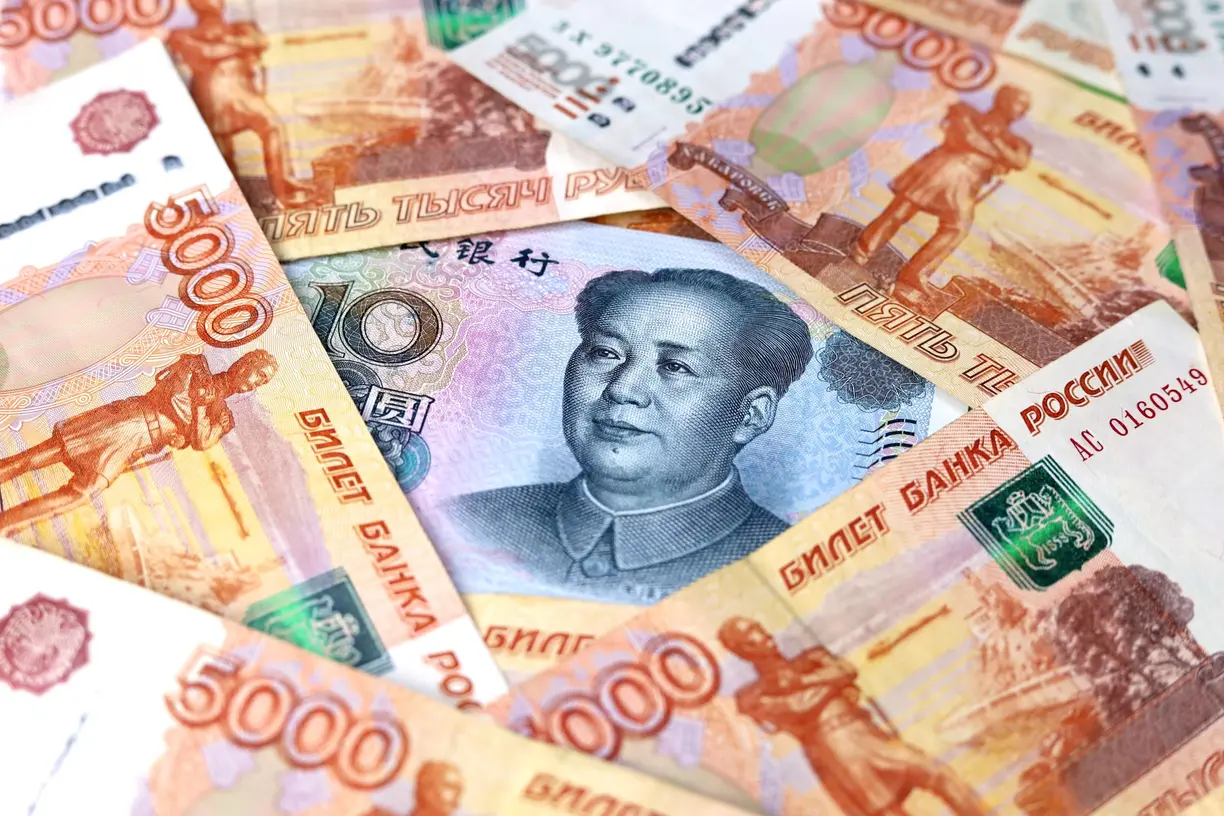
(Kitco News) – The Central Bank of Russia (CBR) shocked international markets and their own financial institutions on Thursday when it announced that China’s yuan would replace the U.S. dollar as the benchmark for all currency trades in the country.
The announcement was one of several issued by the CBR during a frantic day of activity that saw the Moscow Exchange (MOEX) suspend trading in dollars and euros following a new series of U.S. sanctions in response to Russia's ongoing invasion of Ukraine.
The central bank said the measure was taken due to a "redirection of trade flows to the East and the change in the currency of settlements to rubles, yuan and other currencies of friendly countries," referring to states like China, Serbia, Mexico and Brazil that have not joined the Western sanctions regime.
"The exchange rate of the yuan/ruble will set the trajectory for other currency pairs, and will become the benchmark for market participants," they said.
Earlier in the day, the CBR also announced the suspension of trading in the Hong Kong dollar because it is pegged to the U.S. dollar, and delayed the opening of the Moscow Exchange.
“The Bank of Russia has decided to suspend trading in Hong Kong dollars from 13 June,” the central bank’s press service said in a release. “On Thursday, trading sessions in the MOEX FX and precious metals markets and derivatives market with settlements in foreign currencies other than the US dollar, euro, and the Hong Kong dollar starts at 9.50 Moscow time.”
These moves came in response to the Wednesday announcement of new sanctions from the U.S. Office of Foreign Assets Control (OFAC), which include targeting Russian banks that act as intermediaries for U.S. dollar trades through the Russian FX markets.
“Today’s actions ratchet up the risk of secondary sanctions for foreign financial institutions that deal with Russia’s war economy; restrict the ability of Russian military-industrial base to take advantage of certain U.S. software and information technology (IT) services; and, together with the Department of State, target more than 300 individuals and entities both in Russia and outside its borders—including in Asia, the Middle East, Europe, Africa, Central Asia, and the Caribbean—whose products and services enable Russia to sustain its war effort and evade sanctions,” the OFAC said in the statement.
“Russia’s war economy is deeply isolated from the international financial system, leaving the Kremlin’s military desperate for access to the outside world,” Treasury Secretary Janet Yellen said. “Today’s actions strike at their remaining avenues for international materials and equipment, including their reliance on critical supplies from third countries. We are increasing the risk for financial institutions dealing with Russia’s war economy and eliminating paths for evasion, and diminishing Russia’s ability to benefit from access to foreign technology, equipment, software, and IT services.”
The pivot to the yuan is something that many experts in Western markets had been speculating about, but the speed and disorder with which it was adopted today came as a surprise to even seasoned Russia-watchers. China’s trade with Russia has increased dramatically since the Feb. 2022 invasion of Ukraine, reaching a record value of $240 billion in 2023.
Russian President Vladimir Putin has consistently attempted to put a positive spin on the forcible de-dollarization of Russia’s financial and trade relations, and has held up the BRICS partnership as a viable alternative to the Western economic systems.
The new CBR rules mean that banks, companies and investors cannot trade U.S. dollars or euros through a central exchange, and must now rely on over-the-counter deals conducted directly between two parties.
The moves clearly took Russian financial firms completely by surprise, as reports are being shared on X (formerly Twitter) of the websites of many banks and institutions crashing or not allowing users to log into their accounts.
Russian media report that websites of several large Russian banks are not downloading or not allowing clients to log in.
These include Rosbank, Gazprombank, and Moscow Stock exchange. https://t.co/Qik83E2NXT pic.twitter.com/2B1tInSPjS— Anton Gerashchenko (@Gerashchenko_en) June 13, 2024
