

(Kitco News) – The public perception of Bitcoin (BTC) has undergone a notable shift over the years, as the crypto asset class that was once considered the preferred method of laundering ill-gotten gains is now supported by some of the largest asset managers on the planet.
While well-known figures such as BlackRock CEO Larry Fink and MicroStrategy founder Michael Saylor have served as the best spokespeople the industry has had to date, the younger investing crowd is now driving interest as those who have grown up online are more open to the idea of digital money.
With the major stock indices trading near record highs and real estate out of reach for many under the age of 45, cryptos have emerged as the best wealth-building opportunity for millennials and Gen Zers, who currently own just 74 cents for every $1 of wealth that baby boomers owned at the same age.
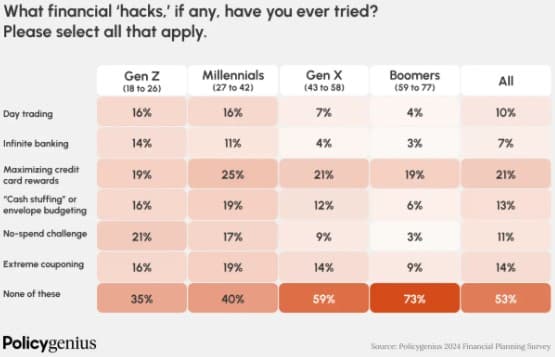
According to the Policygenius 2024 Financial Planning Survey, “younger generations are almost equally likely to own cryptocurrency (21%) as they are to own real estate (20%) and more likely to try financial ‘hacks,’” such as no-spend challenges or infinite banking, which involves borrowing against a whole life insurance policy.
With home affordability at its lowest point since the Great Recession due to a combination of higher interest rates, stagnant incomes, and low housing stock, Policygenius senior reporter Myles Ma said “It's not surprising that only 20 percent of Gen Z and Millennial adults surveyed own real estate.”
“In addition to real estate, zoomers (ages 18 to 26 at the time of the survey) are less likely than older generations to own stocks,” he added. “Gen Z and millennials (ages 27 to 42) are much more likely to invest in alternative assets like cryptocurrency and non-fungible tokens (NFTs) compared to their older counterparts.”
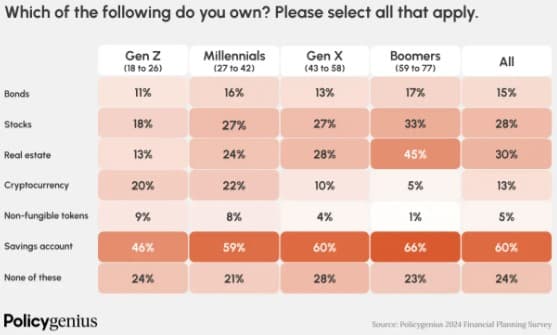
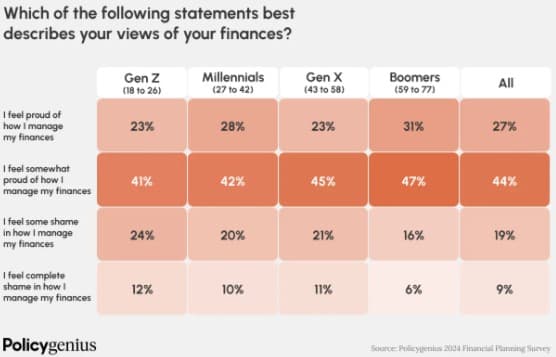
Members of the baby boom generation (Boomers) were found to be the most proud of their financial situation, which is likely why this cohort shows the least interest in cryptocurrencies. “If it ain’t broke, don’t fix it,” is the motto for these investors as Boomers are wealthier on average having been in the real estate and stock markets during the best conditions of the last century.
The struggle of younger generations is evidenced by the use of ‘hacks’ intended to improve their financial situation. According to the survey, “62% of these younger generation members have tried at least one of six financial hacks listed in the survey (see below), compared to 36% of older generations.”
The survey was conducted online from Oct. 16 - 19, 2023, before the launch of spot BTC ETFs on the U.S. market, so it’s likely that the figures presented have changed some, especially since BTC climbed from $30,000 around the time of the survey to a new record high above $73,800.
That said, retail interest in digital assets remains below the highs seen in 2021, according to Joe Vezzani, the CEO of social media analysis platform LunarCrush, who said retail investors are not yet “believing the hype.”
Vezzani noted that compared to the last major bull run, social interactions and overall retail interest are “still quite low.”
“In terms of the number of creators and influencers posting daily, we have witnessed growth,” he said. “However, the notable change we are not observing is in the level of engagement with those creators.”
Vezzani said that the technical and complicated nature of certain aspects of the market, including the Bitcoin halving, remains a challenge for the average user to grasp, limiting their engagement.
“Bitcoin is already challenging for newcomers to grasp, and when we introduce concepts like halving, we risk alienating the public and diminishing their interest in that discourse,” he said.
A recent survey by Deutsche Bank highlights the unengaged nature of retail investors, finding that about one-third of those surveyed expect Bitcoin to slide below $20,000 by the end of the year, a decline of more than 70% from its current price of $69,100.
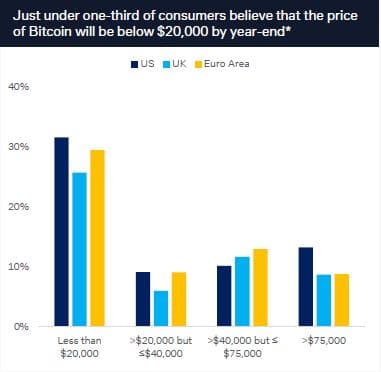
That would put Bitcoin at levels last seen during the deep bear market of 2022, prior to the launch of spot BTC ETFs in the U.S. Out of the 3,600 people surveyed, just over 10% said Bitcoin would be above $75,000 by the end of December, an increase of just 8.3% from its current price.
40% of respondents said that Bitcoin would thrive over the next few years, while 38% expect it to disappear.
The survey didn’t provide a breakdown of responses by age, nor did it provide the reasoning behind why respondents answered in the way they did, so it's unclear what they believe could prompt such a pullback for Bitcoin after seeing record-setting inflows into the spot BTC ETFs.
Demand is also predicted to increase in the months ahead as banks like Morgan Stanley and UBS race to offer their clients access to the ETFs, while large asset managers in China are reportedly looking to access the Bitcoin ETF market via Hong Kong, prompting many analysts to declare that Bitcoin could soon reach the highly anticipated $100,000 level.
Multiple Chinese institutions to launch Bitcoin ETFs in Hong Kong.
This includes the $230 billion Harvest Fund and the $284 billion China Southern Fund.
Giga Bullish!!! ?— Lark Davis (@TheCryptoLark) April 9, 2024
