

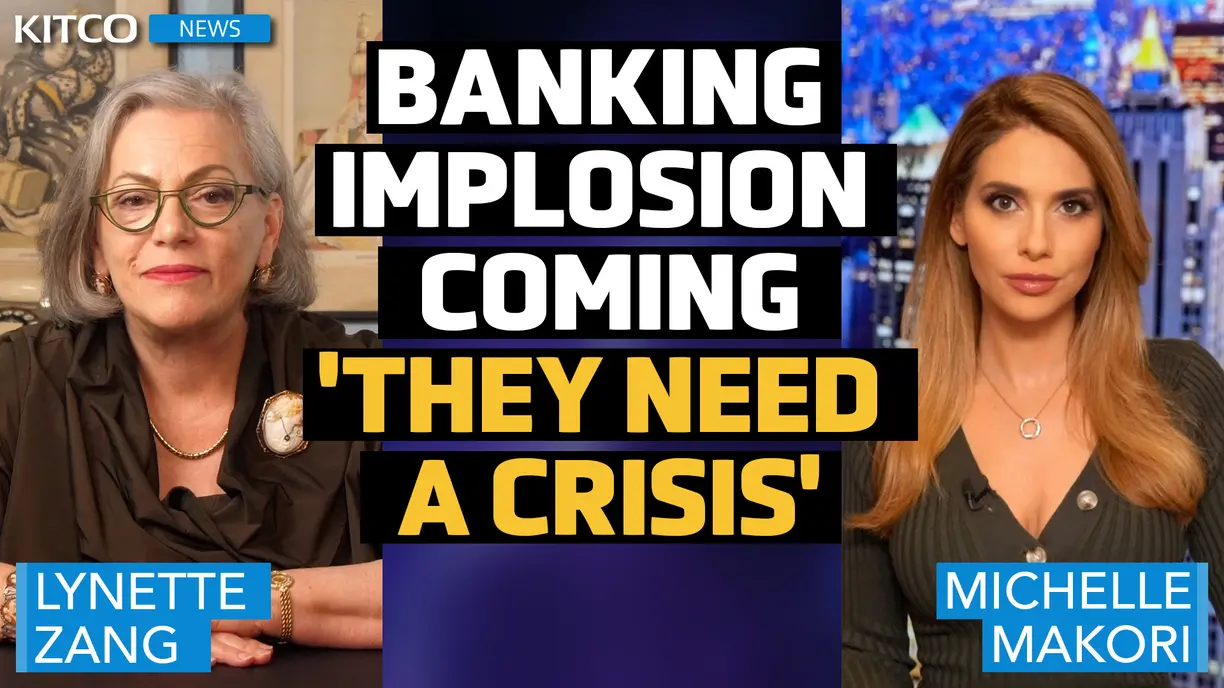
(Kitco News) - The banking sector’s troubles might be out of mainstream headlines, but the crisis is far from over, with the risk of an implosion and consolidation of banks still extremely high, warned Lynette Zang, Founder & CEO of Zang Enterprises & LynetteZang.com.
A little more than a year since the March 2023 banking crisis, when the U.S. saw three of the four largest bank failures in its history, the banking sector is arguably even more vulnerable.
“I believe we will definitely see even more banks collapse,” Zang told Michelle Makori, Lead Anchor and Editor-in-Chief at Kitco News. “What they're trying to do is engineer a soft landing, but the problem is that we are transitioning into a new system. There's no such thing as a soft landing. They need a crisis. So we will see even more banks collapse this year.”
Zang pointed out that every single bank is insolvent because of what the Federal Reserve has been doing.
“They've been buying up all of this government debt with interest rates at zero or even negative. Now that the interest rates are pushed up to quote-unquote fight inflation, all the valuation of that debt is way underwater. It’s not just commercial real estate,” she said. "If the valuations of all the banks, including the central banks, are based on debt, which they are because the entire system is based on debt. Those interest rates have pushed down the market valuations of all of that debt.”
It is not just about bonds and mortgages, Zang added, noting that it also touches auto loans, student loans, credit cards, and trillions and quadrillions of derivative bets against that debt or against that credit quality. “So yes, every single central bank, every single commercial bank. All of that debt is underwater,” she said.
What will the next banking crisis look like, and what are the triggers? Watch the video above.
In 2023, markets witnessed the collapse of SVB, Signature, and First Republic, which held a total of $532 billion in assets — more than all the assets combined held by the 25 banks that collapsed at the height of the global financial crisis in 2008.
In response, the Federal Reserve had set up an emergency banking program that has now expired. The Bank Term Funding Program offered banks and credit unions a lifeline, enabling them to secure loans for up to a year. Before its expiration at the start of March 2024, nearly $170 billion had been distributed through this initiative, according to the Fed.
However, the expiration of the program means very little because the Fed has adjusted other existing channels of credit to keep things working smoothly in the background, Zang pointed out.
For example, it is working on removing the “stigma” surrounding its discount window — known as the lending facility of last resort, she added.
Fed Chair Jerome Powell told senators in March that the U.S. central bank needs to do more to eliminate the stigma problem. "We need to make sure that banks are actually able to use [the Discount Window] when they need to use it.”
Large banks are cautious about using the discount window because it could signal they are in trouble and attract unwanted attention.
In a March report, the International Monetary Fund warned the U.S. could see another financial crisis due to the banks’ exposure to the tumbling commercial real estate sector and high interest rates. “The high concentration of CRE [commercial real estate] exposures represents a serious risk to small and large banks amid economic uncertainty and higher interest rates,” the IMF said.
Zang also noted to closely watch the private equity sector as this bank crisis unfolds, signaling a major ongoing wealth transfer. For signs of the elite taking over everything from banking to tech, watch the video above.
Mountain of debt and its consequences
The U.S. national debt is above $34.5 trillion, which means that the Fed will be forced to eventually pivot and cut rates, Zang stated.
“For a second, that can look okay, but that's also inflationary … higher inflation erodes confidence when the public can see it. It will be the next big crisis that is not bailoutable that will make it obvious to the public. But there's only one layer of confidence left in here, and that's public confidence in this printing press.”
What will this mean for markets and confidence in the U.S. dollar? Watch the video above.
Is Bitcoin a Trojan horse for CBDCs?
Central bank digital currencies (CBDCs) are being actively developed by most countries with a dramatic increase in development over the last four years. According to the latest data from the Atlantic Council, 134 countries, which represent 98% of global GDP, are exploring a CBDC, up from 35 in 2020.
This upcoming crisis in the banking sector could be used to pave the way to a central bank digital currency (CBDC) in the U.S., according to Zang.
“You need a crisis that's large enough to scare the people to comply. And they're going to give us CBDCs to go out and spend. And even though Fed Chair Powell says, ‘We're not even close to it,’ they're running tests. Here's the thing: their job is to lie,” she said.
Zang outlines the consequences of the CBDC system. Watch the video above to see how she suggests dealing with a CBDC world.
“If you don't have food, water, energy, security, barter ability, wealth preservation, community, and shelter, you're not going to have choices. Because you're going to be beholden to whatever they want you to do,” she said. “They are working voraciously at getting those CBDCs everywhere in the world. Even though the public in many places has spoken and does not want them, they will cram it down our throats.”
Zang also pointed out that Bitcoin could be a Trojan horse to a CBDC. “My personal belief, especially after reading the 1996 NSA, which is a government agency white paper on how to create a mint, is that Bitcoin was the Trojan horse,” she noted. “I don't think it was a coincidence that it came out in January 2009 and quantitative easing started in March.”
Zang speculated that Bitcoin was used to normalize the idea of digital currencies allowing the public to be more receptive to a future CBDC. For insights on how Bitcoin could be a decoy that ushers in a CBDC, watch the video above.
This video is brought to you by iTrustCapital. Why a Gold IRA? It’s the Taxes! Learn more: https://itrust.capital/outlook2024
