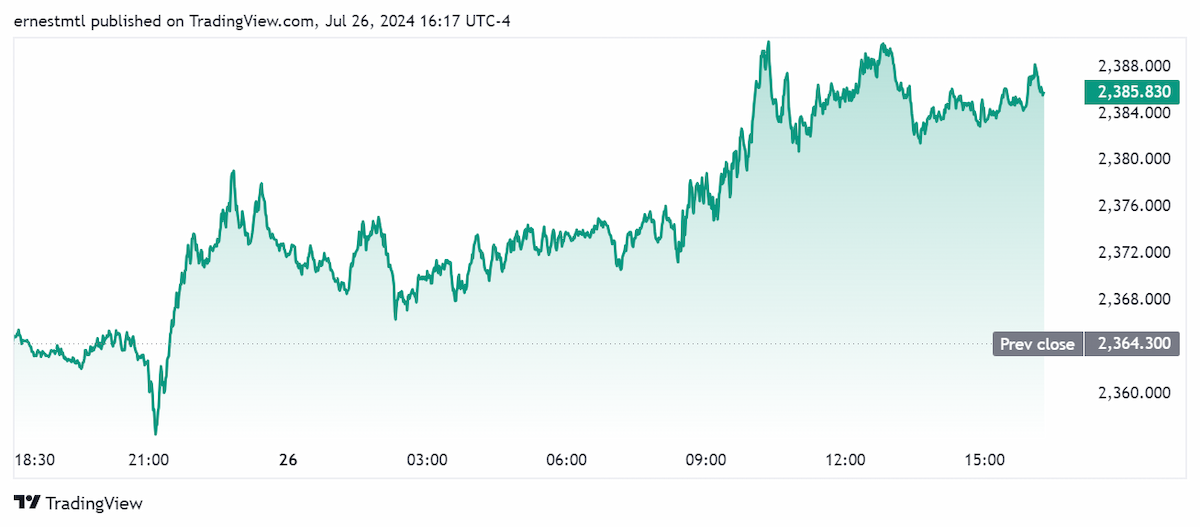

(Kitco News) – Gold traders went on a now-familiar journey this week, as the yellow metal was pushed up during the Asian trading session, only for European and American investors to arrive and either confirm the trend or drive prices sharply lower.
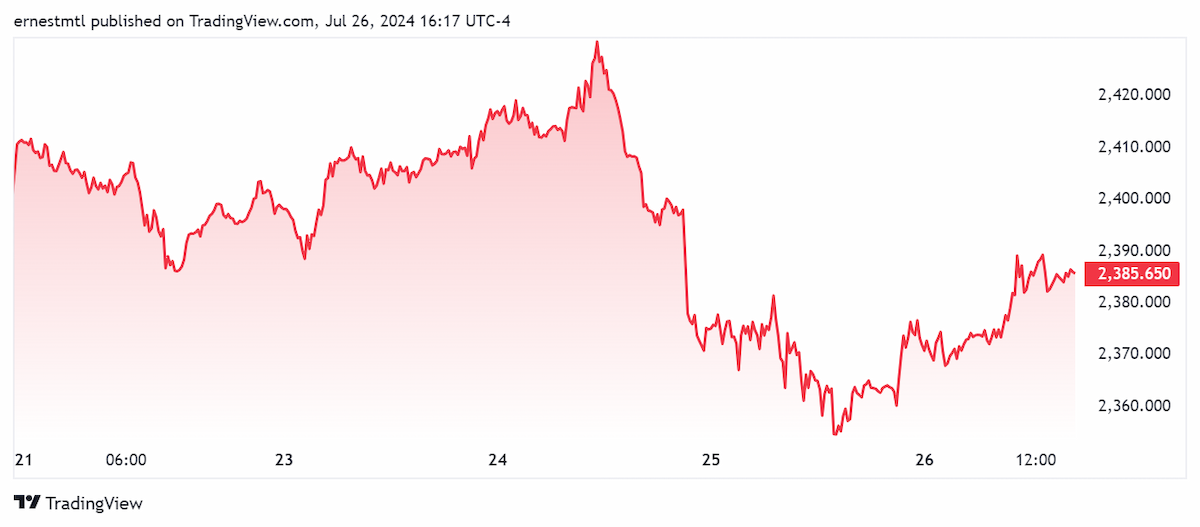
Spot gold kicked off the week trading precisely at the $2,400 per ounce level, which has functioned as strong support and resistance throughout the summer. The yellow metal saw its first sharp correction of the week just before 7:00 am EDT on Monday, falling from $2,407 per ounce to $2,386 by 11:30 am. By Monday evening, Asian traders had pushed the spot price back above $2,400, but their momentum flagged and gold fell once again to the $2,380s by the early morning.
From there, spot gold began its strongest and steadiest climb of the week, rising from $2388.47 at 2:15 am EDT. to the weekly high of $2,430.37 shortly before 11:00 am Wednesday. This elevated level proved unsustainable, however, and spot gold sold off sharply during the remainder of the North American trading session, and fell further still during the overnight, ultimately hitting the weekly low of $2,354.60 per ounce by 1:30 pm EDT on Thursday.
At this level, the yellow metal was once again attractive, and bulls arrived in force to push the price action into the mid-$2,360s by the end of the North American trading session, after which in continued all the way to a double top at $2,376 per ounce around midnight before seeing a slight pullback.
Friday’s North American session brought a mixture of renewed optimism about rate cuts and rollovers on the forward futures contract, propelling gold steadily higher to twice test resistance at $2,390 by early afternoon before pulling back to the mid-$2,380s.
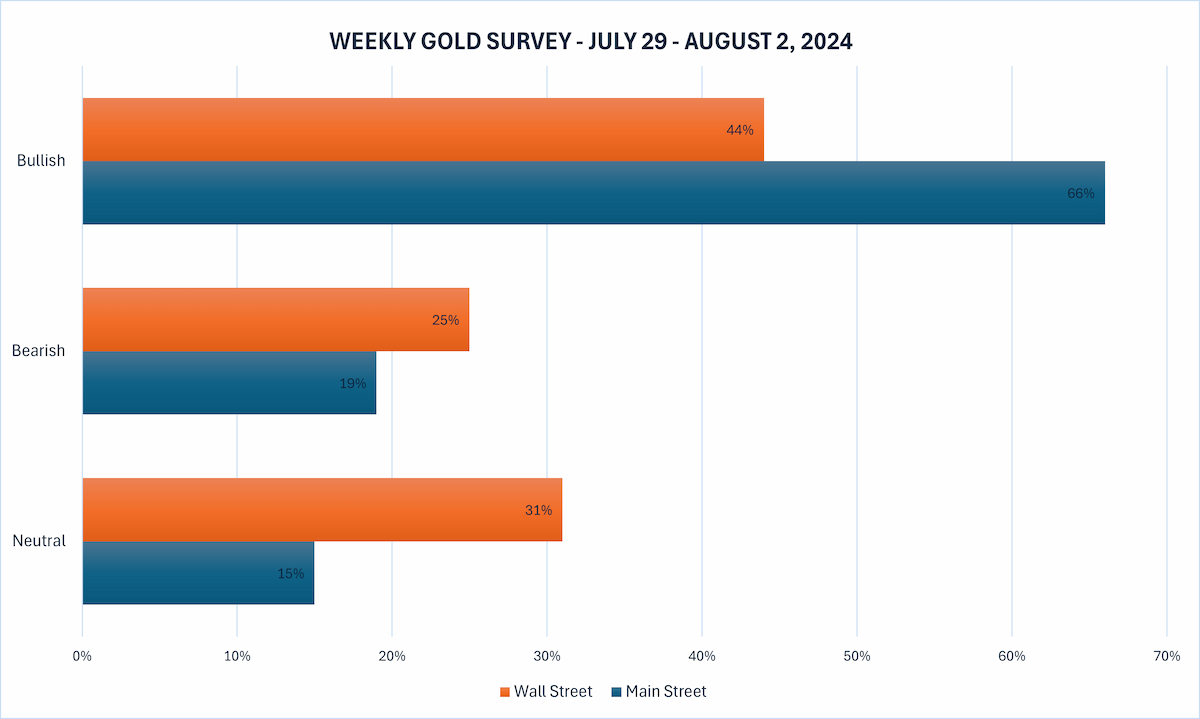
The latest Kitco News Weekly Gold Survey shows industry experts leaning more bullish once again, while retail sentiment further improved from last week.
“I am bullish on Gold for the coming week,” said Colin Cieszynski, Chief Market Strategist at SIA Wealth Management. “My thinking is that If Powell comes out dovish at the Fed meeting and hints toward a Sept interest rate cut, that could push the USD down and help Gold to rebound.”
“I even look at Core PCE inflation today, which was neutral to slightly hawkish and yet USD is down, treasury yields are down, and gold is up,” Cieszynski added.
“Down,” said Darin Newsom, Senior Market Analyst at Barchart.com. “Based on the idea Dec gold closes lower for the week this Friday, another round of selling next week could lead to a third consecutive lower weekly close. Support on the contract’s weekly chart is at a series of lows near $2,350. Weekly stochastics remain neutral, well above the oversold level of 20%, meaning there is still time and space for the contract to move lower.”
“I suspect consolidation is the most likely scenario,” said Marc Chandler, Managing Director at Bannockburn Global Forex. “Gold in the cash market approached my target (~$2350) and found support to recover to almost $2380 at the end of the week. The momentum indicators are still falling, and the five-day moving average is crossing below the 20-day average for the first time since very early in the month. The $2400 area offers resistance.”
“Up,” said Adrian Day, President of Adrian Day Asset Management. “Gold will rise as the chances of a near-term rate cut by the Federal Reserve increase.”
“Still cautious,” said Mark Leibovit, publisher of the VR Metals/Resource Letter. “Risk to 1900-2000.”
Kevin Grady, President of Phoenix Futures and Options, said much of the price action this week was driven by weak earnings reports and rollovers between the futures contracts.
“I think if you look at the days that gold sold off, I think they correlated with the big drops in the S&P,” he said. “There's two things that are happening here. One, gold right now, is in a big rollover. The Aug contract is rolling over to Dec. That's a major deal. It's a major deal for the funds, it's a major deal for the banks, it's a major deal for everybody.”
“When you look at a roll, there's an ebb and flow,” he added. “The index rolls are always passive; they're always long, and they always stay long, so that position doesn't change. But a lot of the shorter-term funds wait until the end, because they just say, ‘Hey, you know what? If the price is coming off, I don't want to get out of my position and pay to roll it into December and then have to liquidate if something happens like a selloff.’ Which is basically what happened.”
“A lot of those positions hold until the very end, so I think you also had margin selling coming because of those big S&P selloffs,” Grady said. “You saw big drawdowns in those S&P positions, and I think people had some profitable positions in gold, and they said, ‘you know what? Let me liquidate some of these and raise some of that capital.’”
“I think as equities are rallying back now here today, you're starting to see some people buying some back.”
“If you just look at the big picture of where gold actually is, you need to sell off like that,” Grady added. “It's healthy. Even the S&P selloff is healthy. You can't have everything just keep going straight up. And I think it shakes out a lot of the short-term trend followers.”
Grady said that in the near term, he expects gold to continue to take its lead from equities, which means the price action is skewed to the upside. “I think it's going to stay stable to higher, because equities will stay stable to higher,” he said. “There's a lot of noise [in the markets], but primarily, I think gold's going to stay steady.”
He also expects the Fed to remain supportive of the yellow metal. “I think the [PCE] number today is going to help,” he said. “The assumption would be that today's number is going to help with some verbiage [from Powell] towards those rate cuts. That would be consistent with what's going on.”
This week, 16 analysts participated in the Kitco News Gold Survey, with Wall Street showing renewed optimism about the near-term prospects for the precious metal. Seven experts, representing 44%, expect to see gold prices rise next week, while only four, or 25%, now predict a price decline. The remaining five analysts, or 31%, see gold trending sideways during the week ahead.
Meanwhile, 193 votes were cast in Kitco’s online poll, with Main Street investors getting more bullish compared to last week. 127 retail traders, or 66%, looked for gold prices to rise next week. Another 37, or 19%, expected the yellow metal to trade lower, while 29 respondents, representing the remaining 15%, saw prices consolidating within a range next week.
Next week's trading risk will focus on the last two days, with the Federal Reserve’s July interest rate decision and press conference on Thursday afternoon, followed by the release of the U.S. nonfarm payrolls report for July on Friday morning. While the overwhelming majority of market participants expect a hold from the central bank, precious metals traders will be very interested to hear if Fed Chair Jerome Powell's tone shifts in response to this week’s higher-than-expected July PCE inflation report.
Other notable events include Jolts job openings for June and the Conference Board's consumer confidence survey for July on Tuesday, the Bank of Japan interest rate decision and ADP employment on Wednesday, and the Bank of England’s rate announcement, weekly jobless claims and ISM manufacturing PMI on Thursday.
Markets will also receive new data on the beleaguered U.S. housing sector next week, with the release of the S&P-Case Shiller home price index on Tuesday and MBA mortgage applications and pending home sales on Wednesday.
Dennis Gartman, creator of the Gartman Letter, is bullish as ever on the yellow metal and sees any weakness as an opportunity to take long positions. “The correction we have seen in gold in the last two weeks just gives people a better chance to buy it. Gold has been in a bull market for a long time now and will remain in one for the foreseeable future.”
Sean Lusk, co-director of commercial hedging at Walsh Trading, was looking at the price action on Friday and adjusting his expectations for gold along with the broader market.
“My target was $2,485, 20 percent higher on the year, and we hit it; we traded $2,488,” he said. “But the pullback here, it's just so crazy because you get these huge moves, and there was some uneasiness in the stock market and we saw some pullbacks in there, and some of it was warranted. But now you're getting right back up there and what's gold doing? It’s coming right back up.”
Lusk said it’s hard to bet against gold when so much of the geopolitical, economic and financial world is in flux. “China's been out of the market here for a couple of months, but maybe they come back in,” Lusk said. “Now there's major uncertainties with the election. They already tried to take out Trump almost got it. The uncertainties here are just soaring, so are the ‘black swans.’ You’ve got to think, from a gold perspective, any dip like what just occurred may be a tremendous buying opportunity.”
Lusk sees both upside and downside risk to gold prices at the current levels. “If we can't hold the $2,285, $2,290 area, then we're going to be down another $100 from there to the 5 percent threshold,” he said. “We're sitting at 15 percent higher on the year at $2,385. We just broke a little over 5 percent on this break in a really short amount of time. But when you get up to these levels, you have a lot of itchy trigger fingers here, and with the algos doing what they do, the big swings and the increases in volatility can bring it right back up to those highs, or near them.”
“Look at where the credit markets are,” Lusk added. “They're putting in 119.19 here; we were just up at 120.17, and the market bent back two full handles down to 118, and now it's starting to churn up again. That's good for gold, should that remain the trend.”
“At least for today, yields are coming off here, futures are rising, and that's why gold has got a pop.”
For next week, Lusk will be watching to see what gold prices do at the outset to gauge their direction going into the Fed and NFP. “Gold has to hold $2,350 to $2,340,” he said. “Next week, if it starts below, then we're going down to $2,280, $2,290. If that doesn't hold, then the heat's really going to be on. But you’ve got to think that any significant dip in here is going to be bought by others.”
Alex Kuptsikevich, Senior Market Analyst at FxPro, believes that despite this week’s weakness, gold has bent but has not broken.
“Gold came close to closing lower for the second week in a row, falling to $2372 per troy ounce on Friday morning, $111 below its high on July 17,” he noted. “This decline occurred in two impulses, with an intermediate correction in between, and fits within a 61.8% Fibonacci retracement pattern from the initial decline. The extension of the pattern within the classic expansion suggests a downside target near $2320.”
“On the other hand, gold found buying support on Thursday and early on Friday at the crossover of the 50-day moving average near $2360,” he said. “This also coincides with the consolidation centre of the repeated pullbacks from April to June. This means that the decline in this area is well within the framework of a correction, and it is not yet possible to claim that the gold rally has broken and that a top has been established for many months and years to come.”
Kuptsikevich sees two possible lines of defense for the yellow metal in the near term: $2,360 and $2,320. “It is worth keeping a close eye on the price action around these levels,” he said. “If gold breaks through them with a strong move, we should be prepared for a prolonged decline. If the buyers manage to break the trend near one of these lines, the price may well continue to rise on buyers' encouragement.”
“Gold's ability to avoid a sell-off in June after breaking the 50-day probably helped it make new highs in July,” he concluded. “This story could be repeated if the financial markets avoid another deep sell-off and return to growth even without an official correction (a fall of more than 10% from the peak).”
Phillip Streible, Head of Market Strategy at Blue Line Futures, expects gold prices to trend sideways in the near term. “It will take a move back above $2,434.20 to shift markets to a bullish trend,” he said.
“I warned trade below 24648-12 will warn of pressure, likely decent—we have come off $109.3,” said Michael Moor, Founder of Moor Analytics. “The trade below 24110 (+2.5 tics per/hour) projects this downward $60.00 (+)—we have seen $59.1 so far. The trade below 23882 (+1 per/hour) has brought in $36.3 of pressure. If we settle below 23440, this should open up a run for 23047 (-). We are likely in a bearish correction/trend against the move up from 19002.”
And Kitco Senior Analyst Jim Wyckoff said he expects the recent consolidation to continue next week. “Sideways and choppy,” he said. “Some near-term technical damage has been inflicted this week, and the bulls are wounded. The need to step up and show more power next week, to avoid more chart damage.”
Spot gold last traded at $2,385.69 per ounce, gaining 0.90% on the daily chart but losing 0.75% on the week.