(Kitco News) – Precious metals investors went for another wild ride this week, with gold getting buffeted by positive and negative news, but enjoying a very strong week on balance.
Spot gold kicked off the week trading at $2,391.62 per ounce, and trended steadily downward on Sunday night and into Monday’s North American trading session before news that China central bank had refrained from gold purchases for the second straight month drove the yellow metal from $2,378 per ounce to a low of $2,354.30 shortly after noon EDT.
From there, gold traded in a relatively narrow $15 range for much of the week, testing the low $2350s once more on Tuesday before trending steadily upward through two days of relatively dovish congressional testimony from Federal Reserve Chair Jerome Powell before markets turned their attention to the pair of U.S. inflation reports due later in the week.
When the June CPI report came in significantly better than expectations on Thursday morning, traders responded by driving spot gold from $2,379.12 to $2,407.66 in a matter of minutes, and by 11:15 am, the yellow metal had posted its weekly high above $2,420 per ounce.
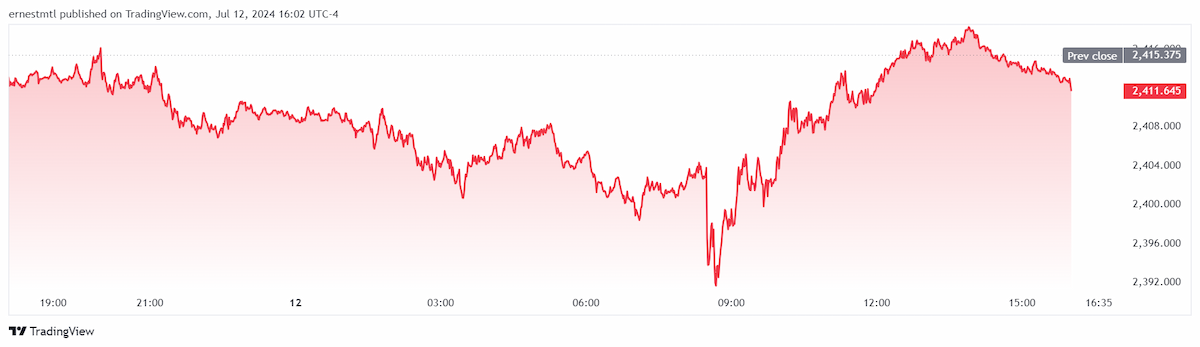
The market then turned its focus to Friday morning’s PPI release, and the disappointing headline prints caused only a momentary slide to $2,392.51 before prices rebounded and spot gold once again began climbing above the $2,400 per ounce level, topping out only a couple of dollars short of the Thursday high just before 2:00 p.m. EDT.
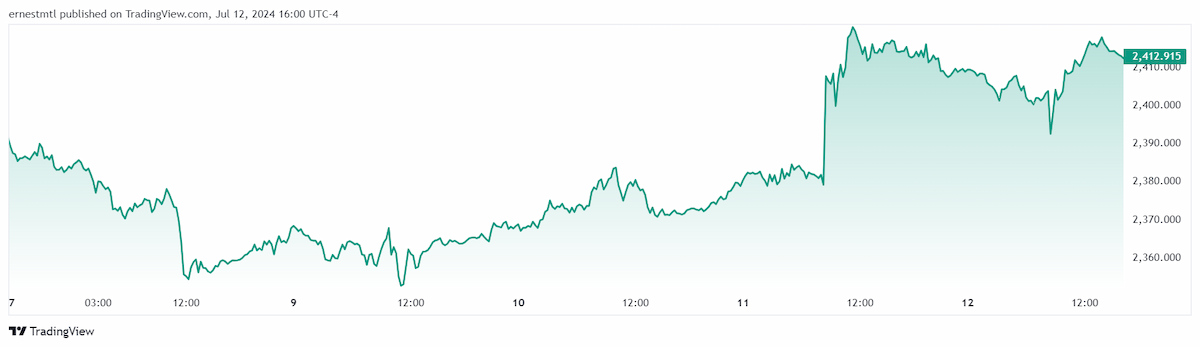
At the time of writing, spot gold continues to trade well above $2,400 per ounce and within $10 of Thursday’s multi-month high.
The latest Kitco News Weekly Gold Survey shows industry experts nearly unanimous on gold’s bullish prospects for the coming week, while retail sentiment is also firmly in optimistic territory.
Marc Chandler, Managing Director at Bannockburn Global Forex, said the trend remains upward for the yellow metal.
“Gold rose for the third consecutive week, helped by lower US interest rates and a weaker dollar,” he wrote. “It surged to almost $2425 after the soft CPI reading and elevated speculation that the Fed may cut rates more than twice this year (~40% chance of a third cut). Some near-term consolidation looks likely, but market sentiment is constructive.”
“Ironically, and not to be lost in the shuffle, is that it is not higher inflation that lifted gold as a popular narrative suggests, but the implications of falling inflation (for the dollar and interest rates),” Chandler said. “Separately, we note that although the PBOC may not have bought gold last month, other central banks in Asia and Europe reportedly have, and a survey by UBS (40 central banks) found the biggest concern was geopolitical tensions and the weaponization of reserves.”
“Up,” said James Stanley, senior market strategist at Forex.com. “In my opinion, this is still in bulls’ control and the fact that they held support through Q2, even with multiple bearish formations in play, highlights that control element well. I think $2,500 is still very much doable.”
“Down,” said Darin Newsom, Senior Market Analyst at Barchart.com, who was the lone doubter this week. “It’s going to be tight, but if the August contract can hold onto a weekly gain through Friday’s settlement it would be the third consecutive higher weekly close within a continued intermediate-term downtrend. This brings to mind a typical Benjamin Franklin Fish Analogy that tells us: Like guests and fish, markets start to stink after three days/weeks/months (whatever timeframe is being studied) of moving against the trend."
"From a technical point of view, August could be moving into a short-term downtrend on its weekly chart after reaching the target area between $2,411.10 and $2.440.10 this week,” Newsom said.
Sean Lusk, co-director of commercial hedging at Walsh Trading, was unraveling the week’s contradictory U.S. data to determine the likely path for gold and the broader economy.
“You had bearish data from the PPI,” he noted. “The dollar went higher for a bit and then, everything set back on weak consumer sentiment. So does really one offset the other here? I guess it could. I just feel that with everything going on in Washington and everywhere else, why in the hell would you want to be short gold?”
“Gold, from the recent run-ups and the highs in the spring, we've consolidated, but in this environment, the path of least resistance is definitely higher,” he added. “My target, 20 percent higher on the year, is $2,485. I believe that's where we're going. So in that vein, I think you buy this thing, or I think it's a continued buy.”
Lusk said that if we view the recent data through the lens of the Fed’s dual mandate, he doesn’t think much has actually changed. “Jobs and inflation, that's the numbers that matter,” he said. “You get these rosy pictures, and some moron in June said we had a blowout number. We didn't. That number was revised, and the prior spring numbers were revised lower. They weren't hugely lower, but it wasn't the gains that were previously reported. The BLS is BS, and you can quote me on that.”
Lusk said the jobs that the U.S. economy has created have been very concentrated in government, healthcare, and other public-funded areas rather than in the private sector, and the government programs that are supporting those job gains are temporary and also inflationary.
“We have this back and forth,” he said. “One reading is bad for inflation, one is good. One is good, one is bad. This week was a perfect microcosm of that. I don't know how that changes, because if you don't cut spending over here and anywhere else, what's the damn point?”
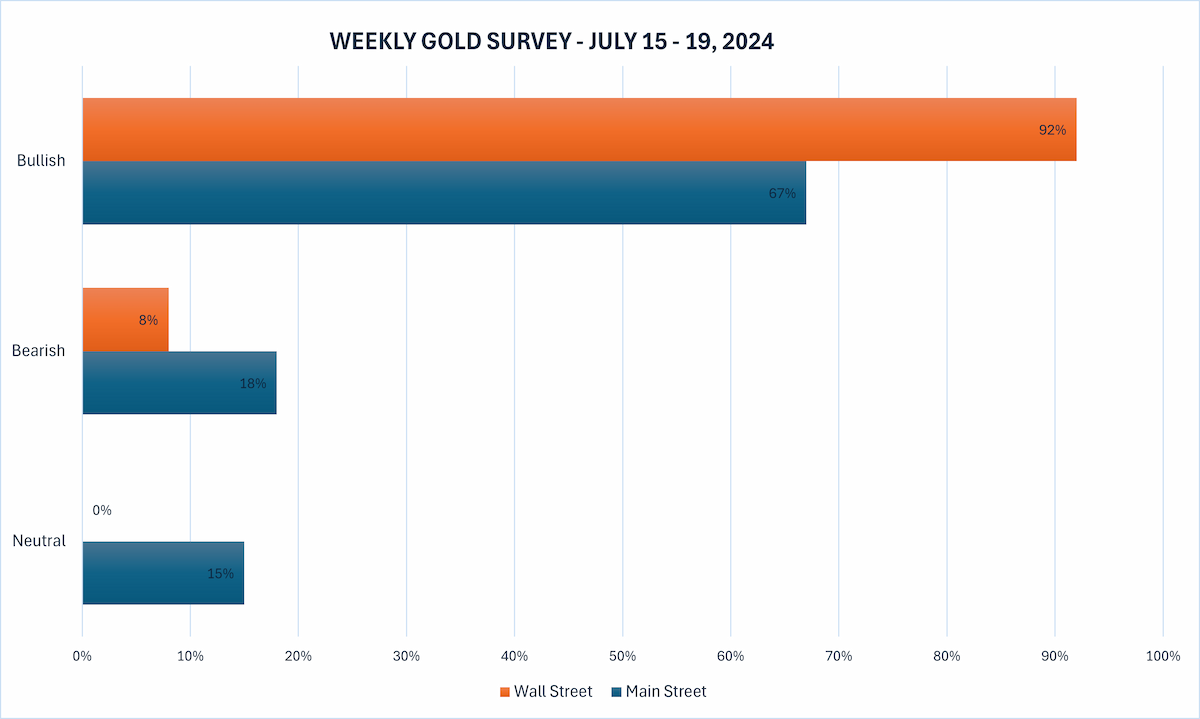
This week, 13 Wall Street analysts participated in the Kitco News Gold Survey, and with but one exception, they all agreed that the yellow metal was set to go higher. 12 experts, or 92%, expect to see gold prices post further gains next week, while just one analyst, representing 8%, predicts a price decline. None saw gold trending sideways in the week ahead.
Meanwhile, 178 votes were cast in Kitco’s online poll, with Main Street investors maintaining their bullish stance from last week. 119 retail traders, or 67%, look for gold prices to rise next week. Another 32, or 18%, expected the yellow metal to trade lower, while 27 respondents, representing the remaining 15%, saw prices trading sideways during the week ahead.
Next week, markets will shift their focus from the Federal Reserve to the European Central Bank, which will announce its interest rate decision on Thursday morning. Markets are priced in for a hold from the ECB after the central bank cut its benchmark interest rate in June, but they will also be attentive to signals of potential future cuts.
The most significant North American data release will be U.S. retail sales data for June on Tuesday, with economists warning that further weakness in consumption could add more momentum to market expectations for a September rate cut.
Markets will also be paying attention to the Empire State manufacturing survey and comments from Fed Chair Powell on Monday, U.S. housing starts and building permits on Wednesday, and the Philly Fed survey and weekly jobless claims on Thursday.
Alex Kuptsikevich, senior market analyst at FxPro, noted that gold’s climb above $2,400 bodes well for prices, and he sees potential for a new all-time high that’s hundreds of dollars above the previous one.
“A soft US CPI report pushed gold above the $2400 mark,” he said. “The price only climbed above it for a couple of hours in April and barely spent three days above this level in May. In both cases, these climbs shifted the balance to the sellers, followed by a dip below $2300. These episodes may have created a knee-jerk reflex, as the troy ounce price was down about 1% on Friday due to a relatively elevated risk appetite.”
“The gold price is approaching the upper end of the range of the last three months, which could be the end of a consolidation after rallying off the lows of October,” Kuptsikevich said. “There is logic to this idea, as this rally started on policy reversal signals. Recent months have been shrouded in uncertainty due to mixed inflation numbers. And now we are registering a rather high degree of willingness of the Fed officials to start easing soon.”
“From the technical analysis perspective, the potential upside target in gold in case of a resistance breakout is the level of $2850,” he said.
Adam Button, head of currency strategy at Forexlive.com, acknowledged that two days of testimony from Federal Reserve Chair Jerome Powell was significant, but he expected gold to be driven down by the news from China this week.
“China saying they didn't buy any for the second month in a row, that was going to be the whole week right there,” he said. “Monday, we took a dive. People were expecting China to just take the one month off, but they seem to have taken two.”
With China’s central bank such a significant driver of gold’s price action over the last couple of years, Button was surprised that the precious metal’s dip was so shallow and short-lived.
“It is impressive,” he said. “What I wonder is if people really believe that China isn't buying… do we take that at face value? China's not exactly known for transparency. They were front-running themselves by announcing this buying over the last year, and they may have decided it's too costly to flag that. I think there may be a portion of the market that doesn't believe that they've stopped.”
“But if you take that away, the news is that the federal reserve, U.S. inflation fell,” he said. “We're getting closer to rate cuts, or pricing in more rate cuts. Treasury yields fell and gold rallied, so it’s pretty straightforward in that sense.”
Button said that the magnitude of gold’s move is impressive. “Pretty strong rejection of those recent lows,” he said. “We carved out a pretty clear range bottom now. Even today, they tried to sell it a bit and now we're pretty much at the highs.”
Button pointed out that much of the move comes on the back of dollar weakness. “The market appears to be scrambling for dollar alternatives right now, Japan is intervening, and this time, they might have a tailwind with a slowing U.S. economy and slowing U. S. inflation. Intervention doesn't really work when you're fighting the current, but it can work if U. S. fundamentals are deteriorating.”
“It's clear to me that the inflation story is dead,” Button said. “Just imagine people talking about 5 percent inflation! Forget about it, there's no way. I think we're still in a deflationary world. AI is deflationary. Will they stop [the Fed funds rate] at three [percent]? They might try to hold the line at three, but if you're at three in a recession… I think we still might be in a 2015 to 2019 kind of era, where we need to get rates down to 1 or 2%. I don't know if the market is contemplating that. But I think you're going to have some really low inflation reports. Shelter really started to turn in this [CPI report], so that should, for the next year, keep inflation down.”
Button said the rest of the world is starting to look pretty good, and money will be looking for somewhere else to go. “If the AI trade is over, the rest of the world looks a lot better than the U.S. in relative valuation,” he said. “If you're an American and you see the dollar falling, I'm not so sure you want to go invest in Europe. You may just say gold.”
“Then you look around the world, and if central banks are coming to the conclusion that rates are too high and it’s time to cut, that'll be good for gold,” he added. “We'll see if it's got legs, the dollar’s a crowded trade. I think there are people who are looking for dollar alternatives, and they're going to find one in gold.”
Analysts at CPM Group said in a note shared with Kitco News that they continue to see gold as a buy in the near term.
“Gold prices are managing to hold up, supported by rising concerns and uncertainties about political conditions worldwide,” they wrote. “As the United States elections draw closer support for prices would be expected to build.”
“Lower than anticipated U.S. consumer and producer price increases also are supporting higher precious metals prices, as market participants view lower inflation as a leading indicator of lower prices,” they added. “This is counter-intuitive for those who view gold and silver as inflation hedges that rise and fall with inflation, but this is the current market reality.”
CPM said that if prices can hold above $2,400, this could provide the base for gold to set new record highs later this year. “The summer lull that usually occurs around this time of year may be shallow if it does occur or it could have just passed when prices fell toward $2,300 in June,” they said. “Technical strength in prices continues to build.”
And Kitco Senior Analyst Jim Wyckoff said the dovish tilt from the Federal Reserve is continuing to help the technical picture for gold prices. “Steady-higher as charts turn more bullish this week, and Fed leans easier,” he said.
Spot gold last traded at $2,412.27 per ounce at the time of writing for a slight loss of 0.13% on the day but a gain of 0.97% on the week.