
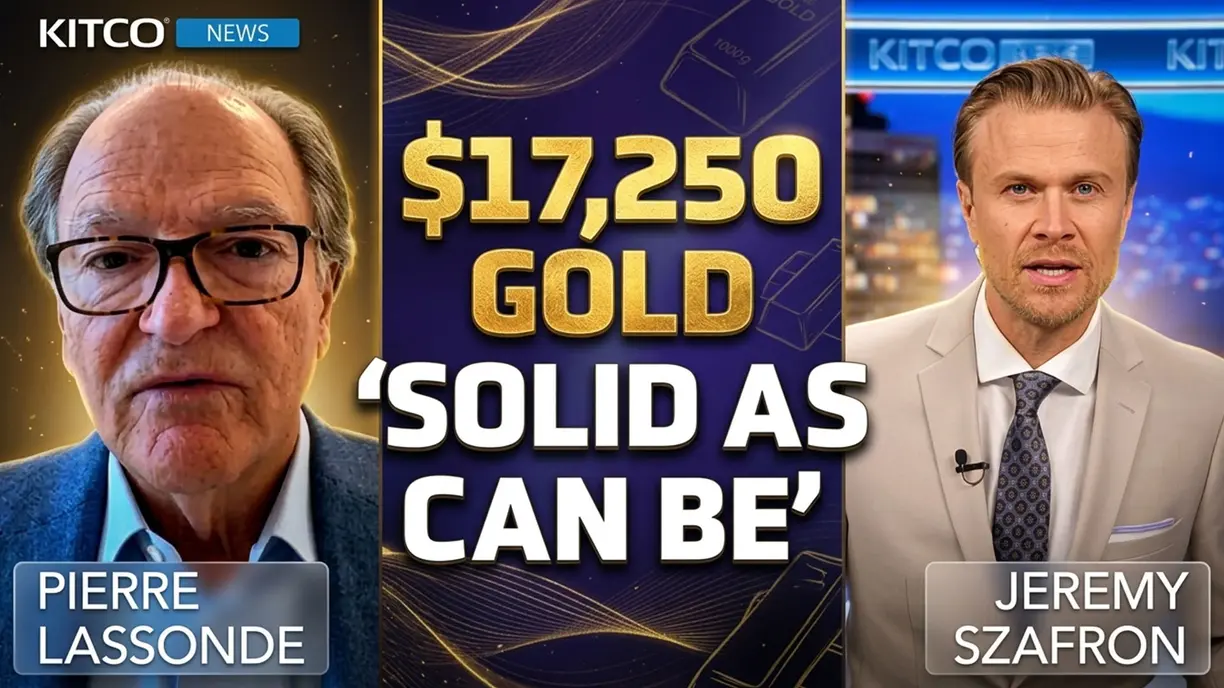
(Kitco News) - The global financial architecture is undergoing a structural transformation that positions gold to reach $17,250 an ounce as it replaces the U.S. dollar as the "currency of last reserve," according to mining legend Pierre Lassonde.
In an interview with Kitco News, the co-founder of Franco-Nevada and former president of Newmont Mining detailed a macroeconomic framework mirroring the stagflationary era of the 1970s, but warned that today’s extreme leverage makes the current cycle far more volatile.
The 1970s Parallel and the $40 Trillion Debt Wall
Lassonde pointed to the late 1970s, where gold saw a tenfold increase as inflation and interest rates climbed simultaneously. However, he noted a critical distinction in the current landscape: the sheer volume of U.S. sovereign debt.
"The total debt in 1981, when Reagan was first elected, was $1 trillion," Lassonde said. "Today, that’s the amount of money that the U.S. has to pay in interest every year because the total debt is approaching now $40 trillion."
Current figures align closely with Lassonde's assessment. As of early May 2026, the U.S. total gross national debt sits near $39 trillion. The burden of this leverage is compounded by higher borrowing costs, with net interest projected by the Congressional Budget Office to account for nearly 14% of all federal outlays in the current fiscal year.
With the U.S. budget deficit projected to exceed 7.9% of GDP, Lassonde argued the Federal Reserve is effectively "monetizing the debt and printing dollars," providing a permanent tailwind for bullion.
"I reiterate that my $17,250 gold price is as solid as can be," Lassonde stated. "I'm convinced we will see this in the next... three years."
Gold as the 'Currency of Last Reserve'
A fundamental shift in how the world settles trade is driving the move away from the greenback. Lassonde noted that China has successfully created a parallel payment infrastructure to bypass U.S. economic sanctions, a system he stated is growing by "50, 100%... every six months." "Gold, 90% of the time is a commodity, but 10% of the time it’s the currency of last resort," Lassonde explained. "When the dollar doesn’t perform its role as currency of last resort, guess what? Gold takes its place, and that’s what’s happening right now."
According to Lassonde, central banks have become the dominant force in the market, diversifying out of the dollar and increasing their gold weightings from less than 10% to over 20% of total reserves.
Recent data confirms this steady accumulation. The People's Bank of China reported its official gold reserves reached 74.64 million troy ounces at the end of April 2026, marking an 18th consecutive month of declared gold purchases. Despite this sustained buying streak, gold still accounts for less than 10% of China's total foreign exchange reserves, leaving significant room for further accumulation.
Lassonde further noted that price discovery is migrating to the Shanghai Gold Exchange, where high retail demand and "casino-type" volatility are beginning to dictate the physical price.

Mining Equities: A 5x Margin Expansion
Despite record prices in gold and silver, Lassonde argued that mining equities remain drastically undervalued because the broader market has not yet recognized the sector's unprecedented operating leverage.
"Most of the miners today... have total cost-in of $1,500, $1,600," Lassonde noted. Recent industry data confirms this trend, showing that average all-in sustaining costs (AISC) have climbed to roughly $1,450 per ounce. However, against current spot prices, this still leaves miners with historic profitability.
"Well, on $4,600, that's $3,000 an ounce margin," Lassonde said. "Think, like gold goes to 17,000, the margins are going to expand by a factor of five. None of that is in the stock price. None of it." Even if gold only reaches $7,000, he pointed out that operating margins would still more than double.
Lassonde praised the current generation of mining CEOs for maintaining "incredibly disciplined" capital allocation. Rather than chasing growth at all costs or making overpriced acquisitions - which he noted was the "bane of all gold stocks" in past cycles - companies are now focusing on self-funded internal growth, paying dividends, and returning capital.
"This is the first time ever that I've seen buybacks in the gold space," Lassonde said, reflecting on his 50-year career.
This new era of discipline is already playing out in the broader market. Major producers have recently reported stronger-than-expected earnings and authorized massive share buyback programs driven by higher production and stabilized costs. However, Lassonde remains skeptical of certain restructuring plans across the majors, specifically Barrick Gold's push toward a North American gold IPO.
"I don't quite understand what Barrick is doing," he admitted, noting that floating 20% of an already-owned asset rarely benefits existing shareholders and often creates market orphans. Ultimately, Lassonde's baseline for operators in the current environment remains remarkably strict. "If you're not making money at $4,600 gold and you're not returning money to your shareholders, you should not be in this business, okay? Like, get outta here," Lassonde stated.
The 'Derelict' State of Canadian Pensions
Lassonde reserved his sharpest criticism for Canadian institutional investors, calling out a systemic lack of domestic investment. He claimed that major pension funds are "derelict in their function" by allocating only a tiny fraction of their capital to Canadian markets. "I find egregious the fact that the Canada Pension Plan has 2% of its money invested in Canadian equities... of which practically none is in the mining sector," Lassonde said, calling it an "indictment" of fund managers.
The structural shift away from domestic markets is a well-documented trend. While the Canada Pension Plan (CPP) has grown its total assets to record highs, only a small fraction is invested within Canada, compared to massive allocations in the United States and global markets. This dynamic extends across Canada's largest pension funds, which collectively hold roughly $1 trillion in U.S. assets.
Despite mounting pressure to increase domestic investment, large funds frequently defend their allocations by pointing to robust foreign returns. Lassonde, however, rejects the notion that global diversification is the only path to yield, pointing out that domestic-focused funds perform comparably.
"If you look at the pension funds that are run totally in Canada, their return is no different than the Maple Eight," Lassonde argued. "They seem to... imply that only by doing this diversification... or by being, like, 98% outside of Canada that they can produce the kind of return that they have."
He strongly urged the federal government to implement tax incentives, such as Australia's franked dividend system, to actively encourage domestic equity investment and revitalize the resource sector.
Looking ahead, Lassonde emphasized that the current bull market is far more than a simple price spike.
"It's already a full mining cycle," Lassonde concluded. "When I see people still on the sideline in the gold market, I’m like, 'What are you waiting for?'"